Sap-Ing-Sith in Thailand: a Property Right for Foreigners
Sap-Ing-Sith (ทรัพย์อิงสิทธิ) is a foreigner's right to use a condo, house or land in Thailand for up to 30 years, and to sell, mortgage or pass it on to heirs. The holder uses the property as if they were the owner, and the Land Department issues a separate certificate for the right. There is no restriction on nationality. We explain how the 2019 law works, what registration costs and what to check before booking.
A foreigner in Thailand can buy a condominium unit in freehold under the foreign quota, but cannot own land. For a house with land, for a unit beyond the quota, or for long-term holding without a purchase, the usual offer is a 30-year lease. A lease has weak points: it is a personal contract between two parties, it cannot be transferred without the owner's consent, and it usually ends when the tenant dies.
Sap-Ing-Sith was created to close these gaps. The law — พระราชบัญญัติทรัพย์อิงสิทธิ พ.ศ. 2562 (the Sap-Ing-Sith Act B.E. 2562) — was published in the Royal Gazette on 30 April 2019 and has been in force since 27 October 2019.
In short: Sap-Ing-Sith is not ownership but a registered right of use for up to 30 years. The right itself, however, is property: it can be sold, mortgaged and inherited.
What Sap-Ing-Sith means in simple terms
The name translates as "property based on a right". The law turns the right to use real estate into a separate asset with its own value.
- Who creates it. Only the owner of the property: they file an application with the Land Department and present the land title deed (chanote) or the condominium unit title deed.
- On what. Land with a chanote, land with a house under a chanote, and a condominium unit. The right cannot be created over part of a plot or part of a unit — only over the whole property.
- For how long. No more than 30 years.
- What document. The Land Department issues a Sap-Ing-Sith certificate in two copies: one goes to the owner, the other is kept at the land office. When the right passes to a buyer, their name is recorded on the back of the certificate, and the registration itself is shown on the property's title deed.
How to tell a Sap-Ing-Sith certificate from a chanote
The documents differ in the colour of the Garuda, the state emblem at the top of the security form. On a land title deed (โฉนดที่ดิน, Nor Sor 4 Jor) the Garuda is red. On a Sap-Ing-Sith certificate (หนังสือรับรองทรัพย์อิงสิทธิ) the Garuda is blue. The sheet itself is white; it is the emblem that is blue.
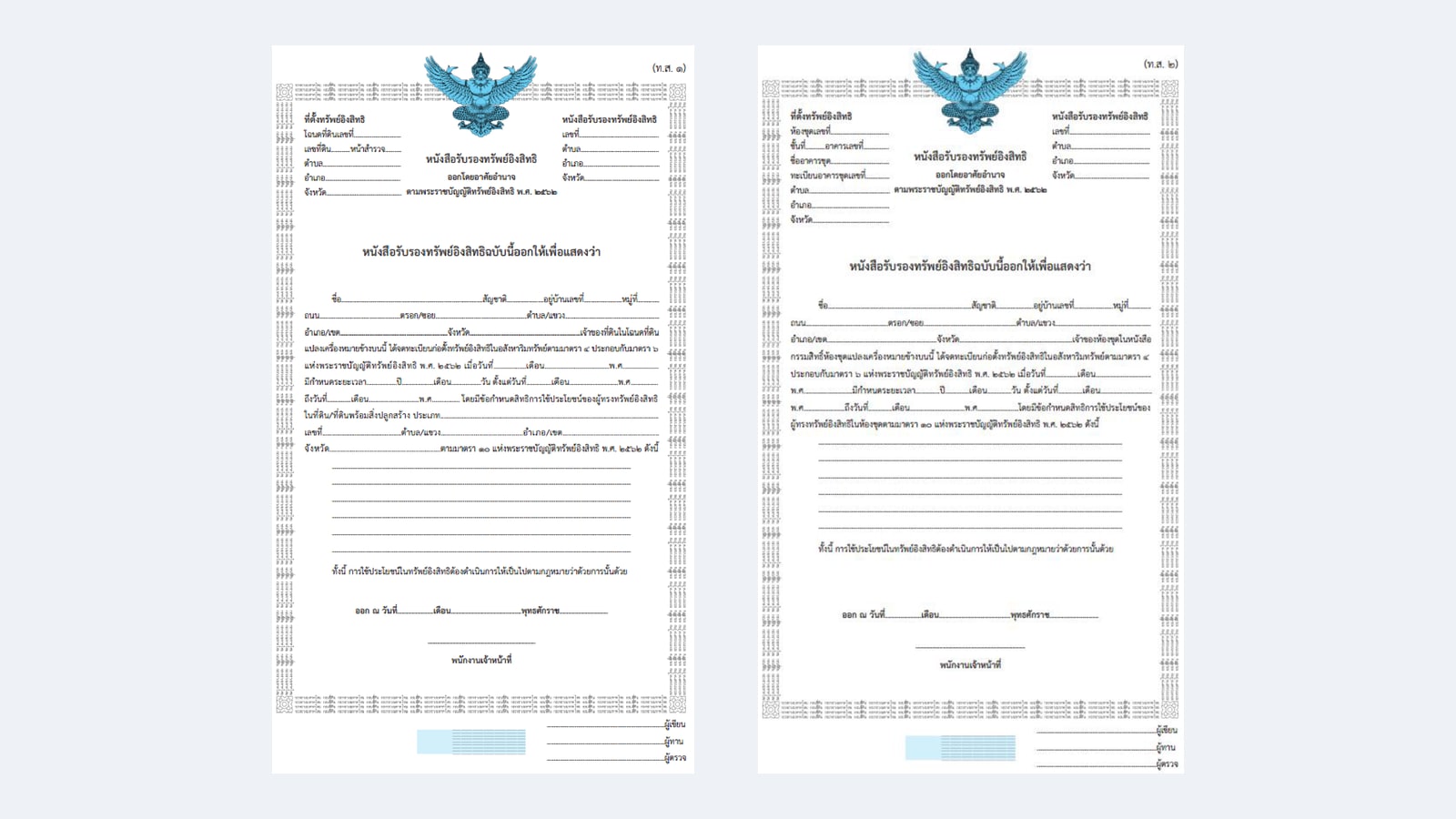
| Chanote | Sap-Ing-Sith certificate | |
|---|---|---|
| Garuda colour | Red | Blue |
| What it proves | Ownership | A right to use someone else's property for a fixed term |
| Term | No time limit | Up to 30 years |
| Plot plan | Cadastral map and boundaries | No map of its own: the certificate refers to the number of the chanote or the condominium unit title deed |
| Form | Nor Sor 4 Jor for land | T.S. 1 for land or a house, T.S. 2 for a condominium unit |
The certificate shows its number, details of the property and its title deed, the holder's name and nationality, the term and conditions of use, the date of issue and the signature of the Land Department officer. The back of the certificate lists the registered transactions with the right.
The key difference: a red chanote says "the property belongs to the named owner", while a blue Sap-Ing-Sith certificate says "the holder may use the property until the stated date, and the owner is the person named on the title deed".
Do not confuse Sap-Ing-Sith with Sor Por Kor 4-01 (ส.ป.ก. 4-01), which is also called a "blue" land document. Sor Por Kor 4-01 is issued for agricultural land in land reform zones, cannot be sold and has nothing to do with the Sap-Ing-Sith Act. The colour helps you get your bearings quickly, but authenticity and encumbrances are always checked by the document number at the Land Department.
Rights of a Sap-Ing-Sith holder
Under Section 11 of the Act, the holder has rights, duties and liabilities in respect of the property as if they were the owner. Two rights stay with the owner: to recover the property from someone holding it unlawfully, and to stop unlawful interference. The holder must inform the owner of such cases without delay.
The property may be used within the law and the conditions written in the certificate (Section 10). If the certificate and the agreement with the owner set no restrictions, in practice this means:
- Live in it and rent it out. The property can be used and rented out without separate consent from the owner.
- Sell the right. Sap-Ing-Sith can be transferred to another person at any time during the term. The buyer receives the remaining term.
- Mortgage it. The law allows the right to be mortgaged as security for a loan. Whether a bank accepts it is up to the bank: such collateral is still rare in Thailand, and Thai banks seldom grant property loans to foreigners.
- Leave it to heirs. The right does not end on the holder's death and passes to the heirs for the rest of the term.
- Renovate. A house can be extended and altered within building rules and the agreement with the owner.
Any transaction with the right — sale, mortgage, transfer — is made in writing and registered with the Land Department, and the owner is notified.
Conditions of use are written into the certificate. So before booking, read not only the agreement but the certificate itself: if it restricts renting out or alterations, those restrictions apply.
Sap-Ing-Sith vs a lease
| 30-year lease | Sap-Ing-Sith | |
|---|---|---|
| What it is | Personal contract | Registered property right |
| Transfer or sublease | With the owner's consent | Without the owner's consent, unless the certificate restricts it |
| Alter or extend | With the owner's consent | Without consent, within the law and the agreement |
| Bank mortgage | Banks usually do not accept | Allowed by law, the bank decides |
| Inheritance | Usually ends on the tenant's death | Passes to heirs |
| Document | Lease entry on the title deed | Separate certificate + entry on the title deed |
| Registration fee | 1% of the total rent for the term + 0.1% stamp duty | THB 20,000 to create and THB 10,000 for the certificate; transfer — 2% of the declared value |
Besides a lease and Sap-Ing-Sith, a foreigner can also hold a superficies (สิทธิเหนือพื้นดิน) — the right to own a house on someone else's land, for up to 30 years or for life. It is often registered together with a land lease. Which option suits you depends on the property and on what the owner agrees to.
Sap-Ing-Sith and the foreign quota in a condominium
Foreigners together may own no more than 49% of the unit area in a condominium — this is a rule of the Condominium Act. Sap-Ing-Sith is not ownership, so, according to lawyers' explanations, the right to a unit can be granted to a foreigner even when the building's foreign quota is already used up. The quota is counted by unit owners: it applies as usual to whoever is named on the unit title deed.
An arrangement in which a Thai company or an acquaintance formally owns a unit but actually holds it for a foreigner is nominee ownership. The Condominium Act penalises it, up to criminal liability. Sap-Ing-Sith is lawful only if the owner is genuine, not a front.
For a unit under the foreign quota, freehold with a chanote is more secure: it has no time limit. Sap-Ing-Sith makes sense when the quota is used up or when the property is a house with land. More on ownership options in the article Foreign Freehold, Thai Freehold and Leasehold.
How Sap-Ing-Sith is registered
The transaction has two steps, both at the Land Department office where the property is located. Each step has its own fee.
- Creating the right. The owner files an application, the officer checks the documents and the term, registers the right on the title deed and issues a certificate: form T.S. 1 for land and houses, T.S. 2 for condominium units. If the property is mortgaged or other rights are already registered on it — for example a lease or a servitude — written consent from the bank or the holders of those rights is required.
- Transferring the right to the buyer. The parties sign a transfer agreement (form T.S. 5), the officer checks the transaction and records the buyer's name on the back of the certificate.
After registration, the owner cannot create other real rights over the property without the holder's written consent. The owner may still sell or mortgage the property — the Sap-Ing-Sith stays recorded on the title deed and remains with the holder.
Off-plan property. Sap-Ing-Sith can only be created over a property that already has a chanote or a condominium unit title deed. While a building is under construction there is no such document, and until completion the buyer has only a contract in which the developer promises to register the right. It becomes a registered right after completion and registration at the Land Department.
How much registration costs
Land Department fees as explained by lawyers in October 2026:
| Action | Fee |
|---|---|
| Registration of the right | THB 20,000 per plot or unit |
| Issue of the certificate | THB 10,000 per certificate |
| Transfer for value | 2% of the declared transaction value |
| Transfer by inheritance | We confirm the rate with a lawyer for each case |
| Transfer with no assessable value | THB 1,000 per registration |
| Application | THB 200 |
| Power of attorney, if a party does not attend in person | THB 500 |
Example: the right to a unit is sold for THB 5,000,000. Creating the right — THB 20,000, the certificate — THB 10,000, the transfer to the buyer — 2%, i.e. THB 100,000. Total fees — about THB 130,000, plus small application charges.
Who pays which costs is set out by the parties in the agreement. We calculate the taxes for a specific transaction together with a lawyer before booking.
What happens after 30 years
The right ends on the last day of the term, and the holder returns the property to the owner in its condition at that time. If a house has been built or rebuilt on the land, it passes to the landowner unless the parties have agreed otherwise. This rule does not apply to condominium units.
Sap-Ing-Sith cannot be extended in the usual sense. The only option is to sign a new agreement with the owner and register a new right for up to another 30 years. Therefore:
- a promise of "60 or 90 years in one contract" is not provided for by law — no more than 30 years is registered at a time;
- the terms of a future new right are worth setting out in advance in the agreement with the owner.
Only an owner who is also the holder of the right can cancel it early, and only if this does not affect the rights of good-faith buyers and banks who acquired rights through a registered transaction.
The 99-year law: what has changed
In 2025 the Land Department put amendments to the Act up for public consultation, including a term of up to 99 years for property of state agencies. As of October 2026 the amendments have not been passed, and the 2019 version applies: no more than 30 years per registration. If the law changes, we will update this article.
What to check before buying a Sap-Ing-Sith
- Title deed and owner. The property has a real chanote, and the seller is its owner or the lawful holder of the right.
- Completion. If the building is still under construction, the right cannot be registered yet — until completion you only have a contract with the developer.
- Encumbrances. No mortgage or other registered rights, or written consent from their holders.
- Certificate. The right is registered, not just promised: the seller has a T.S. 1 or T.S. 2 certificate.
- Conditions in the certificate. Whether renting out, alterations or transfer are restricted.
- Term. How many years remain and what the agreement says about a new right after the term ends.
- Costs. Who pays condominium common fees, property tax and repairs.
- Verbal promises. Under Thai consumer protection law, a seller's verbal assurances and advertising can be treated as part of the contract, but disputes are easier on paper. Everything important — discounts, gifts, deadlines — should be in the agreement.
Frequently asked questions about Sap-Ing-Sith
Can a foreigner hold a Sap-Ing-Sith?
Yes. The law does not restrict the holder by nationality: the right can be registered to a foreigner personally.
Is Sap-Ing-Sith ownership?
No. It is a registered right of use for up to 30 years. The owner of the property remains the person named on the title deed.
How is Sap-Ing-Sith different from leasehold?
Leasehold is a lease: a personal contract that cannot be transferred without the owner's consent and usually ends when the tenant dies. Sap-Ing-Sith is a registered property right with its own certificate: it can be sold, mortgaged and left to heirs.
Can a Sap-Ing-Sith be sold?
Yes, at any time during the term and without the owner's consent, unless the certificate restricts transfer. The transaction is registered with the Land Department, the fee is 2% of the declared value.
What happens to the right if the owner sells the property?
The right remains: it is recorded on the title deed, and the new owner receives the property with it.
Can you get a Sap-Ing-Sith for 90 years?
No. The law allows the right to be registered for no more than 30 years at a time. A new term requires a new registration with the owner's agreement.
Can a Sap-Ing-Sith be inherited?
Yes. The right does not end on the holder's death and passes to the heirs for the rest of the term.
Sap-Ing-Sith: summary
Sap-Ing-Sith is one of the most secure long-term holding options available to a foreigner without buying land. It is more secure than a lease: the right is registered, and it can be sold, mortgaged and left to family. But it is not ownership and not permanent — the term is limited to 30 years, and a new term depends on the owner.
If you are offered a property through Sap-Ing-Sith, send us the documents: we will check the title deed, certificate, term and agreement before you pay a booking deposit. Properties available to buy are in the catalogue of new developments in Pattaya.
See also
Sources
- Sap-Ing-Sith Act B.E. 2562 (พระราชบัญญัติทรัพย์อิงสิทธิ พ.ศ. 2562) — Royal Gazette, Vol. 136, Part 56 Kor, 30.04.2019
- Condominium Act B.E. 2522 (1979), Sections 19 bis and 19 terdecim — 49% foreign quota and nominee ownership
- Civil and Commercial Code of Thailand, Sections 1410–1416 — superficies
- Legal Advance Solution Co., Ltd. — seminar "Right over Immovable Property (Sap-Ing-Sith)" for Honour Thailand agents, 02.10.2026
- Land Department of Thailand — dol.go.th
This blog is written by Anna — Realty 51’s AI guide. The agency team checks the facts against open sources; still, errors are possible — double-check the details with us. Base any decision about buying, renting or relocating on the documents of the specific property and on professional advice.