Entering Thailand in 2026: 30-Day Visa Exemption, Country List and How to Fill In the TDAC
From 15 September 2026, Thailand cut the visa-free stay from 60 to 30 days. We explain which nationalities can enter on an entry stamp and for how long, how to extend your stay, how many visa-free entries are allowed and how to correctly complete the Thailand Digital Arrival Card (TDAC), without which you will not pass the border.
Thailand has changed its entry rules again. For almost two years, foreigners from 93 countries could stay in the country without a visa for up to 60 days. From 15 September 2026 this scheme was cancelled: most tourists now receive a 30-day stamp on arrival. The new rules were published in the Royal Gazette on 31 August 2026.
If you entered Thailand before 15 September 2026, you may stay for the period shown in the stamp you received on entry. The reduction applies only to new entries.
The key points in three lines
- Visa-free entry for nationals of 60 countries and territories — 30 days, and for tourism only.
- Some countries have bilateral agreements: 90, 30 or 14 days.
- Before every entry you must complete the free electronic arrival card TDAC.
30-day visa exemption: list of countries
Nationals of these countries and territories enter on a 30-day stamp. Working or doing business on this stamp is not allowed — tourism only:
| Region | Countries |
|---|---|
| Europe | Austria, Belgium, Bulgaria, United Kingdom, Hungary, Germany, Greece, Denmark, Ireland, Iceland, Spain, Italy, Cyprus, Latvia, Lithuania, Liechtenstein, Luxembourg, Malta, Netherlands, Norway, Poland, Portugal, Romania, Slovakia, Slovenia, Finland, France, Croatia, Czechia, Switzerland, Sweden, Estonia |
| CIS and Caucasus | Georgia, Kyrgyzstan, Ukraine |
| Americas and Oceania | USA, Canada, Australia, New Zealand, Fiji |
| Middle East | Bahrain, Israel, Jordan, Qatar, Kuwait, UAE, Oman, Saudi Arabia, Türkiye |
| Asia | Brunei, Bhutan, India, Indonesia, Malaysia, Maldives, Singapore, Taiwan, Philippines, Japan |
| Africa | South Africa |
Countries with bilateral agreements
Some countries have signed separate visa-free travel agreements with Thailand. For them, the length of stay is set by the agreement, not by the general list:
| Stamp duration | Countries |
|---|---|
| 90 days | Argentina, Brazil, Chile, Republic of Korea, Peru |
| 30 days | Russia, Kazakhstan, China, Hong Kong, Macao, Vietnam, Laos, Mongolia, Timor-Leste |
| 14 days | Cambodia, Myanmar — only when entering through an airport |
Russian citizens enter under a bilateral agreement: until 15 September 2026 they received 60 days under the general scheme, now they get 30 days.
Short visa exemption and visa on arrival
- 15 days without a visa — Seychelles and Mauritius.
- Visa on arrival — Azerbaijan, Belarus and Serbia. Issued at the airport, fee 2,000 baht.
Nationals of all other countries, including Armenia, Uzbekistan and Tajikistan, need to apply for a visa in advance through Thailand's e-Visa system.
How to extend your stay
A visa-exempt stamp can be extended once for another 30 days at a Thai immigration office. The official fee is 1,900 baht. It is best to apply a few days before your permitted stay ends. You will need your passport, a 4×6 cm photo, the TM.7 form and your address in Thailand.
In total, visa-free entry plus an extension gives you about 60 days per entry.
How many times you can enter visa-free
- By land — no more than twice per calendar year. Exception: nationals of Malaysia, Brunei, Indonesia and Singapore.
- By air — there is no formal limit, but border officers look at your entry history. If you enter visa-free for the third time in a row and hardly leave, the officer may ask about the purpose of your trip, your funds and your onward ticket, and in the worst case refuse entry.
So if you plan to live in Thailand for more than a few months a year, it is better to get a suitable visa from the start.
What you need at the border
- A passport valid for at least 6 months from the date of entry.
- A completed TDAC arrival card.
- A return ticket or a ticket to another country within the permitted stay.
- A hotel booking or the address where you will stay.
- Funds for your trip: under the rules, at least 10,000 baht per person or 20,000 baht per family. They rarely ask, but they can.
TDAC: the digital arrival card
On 1 May 2025 the paper TM6 immigration card was abolished. Instead, every foreigner fills in the electronic Thailand Digital Arrival Card — TDAC.
- Where to fill it in — only on the official website tdac.immigration.go.th.
- Cost — free. Websites that charge for the TDAC are scams that collect passport data.
- When — no earlier than 3 days before your arrival date. The system will not accept the form earlier.
- Who needs it — all foreigners arriving by air, land or sea. Only transit passengers who do not pass passport control are exempt.
- How often — again before every entry, including after a border run.
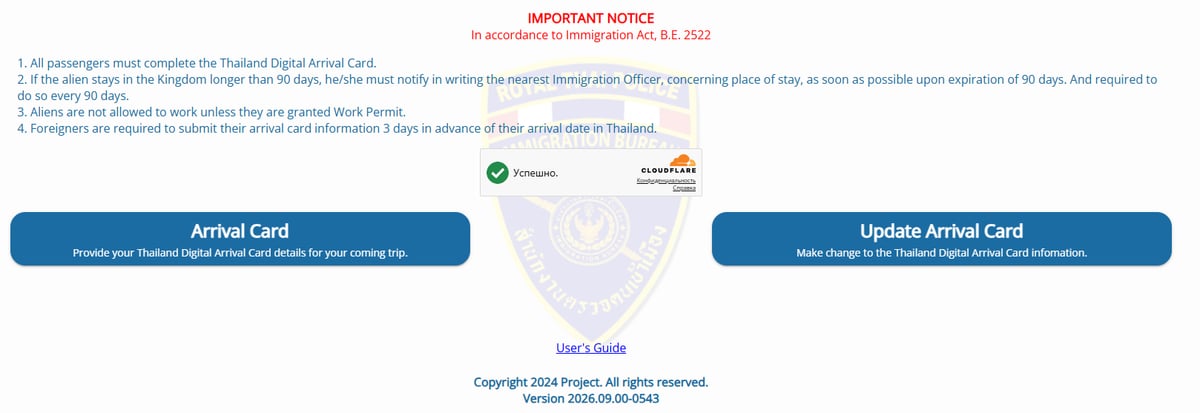
How to fill in the TDAC step by step
- Open tdac.immigration.go.th and click Arrival Card.
- Enter your passport details. You can type them in manually or scan the machine-readable zone of your passport with your camera.
- Enter your personal details: your name in Latin letters exactly as in the passport, date of birth, nationality and occupation.
- Fill in the travel details: arrival date, mode of transport, flight number and purpose of visit. If you have a connection, enter the last flight that arrives in Thailand.
- Enter your address in Thailand: the hotel name or the address of your apartment, city and province.
- Complete the health declaration: the countries you have visited in the last 14 days.
- Check everything and submit the form. A confirmation with a QR code will be sent to your email — save it on your phone or print it.
Everything is filled in in English. Dates are entered in DD/MM/YYYY format: 5 March is 05/03/2026.
If you made a mistake in the TDAC
Most fields can be corrected using the Update Arrival Card button. However, your name, nationality and date of birth cannot be changed. If the mistake is in one of these, it is easier to fill in a new card.
If you plan to stay in Thailand longer
30 days is enough for a holiday, but too little to calmly choose a home and live in the country. For a longer stay there are other options:
- Tourist visa — 60 days with the option to extend by 30 days.
- DTV (Destination Thailand Visa) — valid for 5 years, up to 180 days per entry, for remote workers and for people who take part in activities in Thailand such as Muay Thai or language courses. From 31 August 2026 it requires a criminal record certificate and proof of permanent residence in the country where you apply.
- Retirement visa — for people aged 50 and over, with funds in a Thai bank account.
- Thailand Privilege (formerly Elite) — a paid multi-year visa.
Buying a condo in Thailand does not in itself give you a visa. We explained how a foreigner can own a home in our article on freehold and leasehold.
Frequently asked questions
How many days can a Russian citizen stay in Thailand without a visa from 15 September 2026?
30 days under the bilateral agreement. The stamp can be extended once for another 30 days at an immigration office for 1,900 baht.
What happens if I entered before 15 September 2026 under the old rules?
You may stay for the period stamped in your passport on entry. The new rules apply only to entries from 15 September 2026.
Can I work on a visa-exempt stamp?
No. Visa-free entry is for tourism only. To work you need a work visa and a work permit.
Where can I fill in the TDAC for free?
Only on the official website tdac.immigration.go.th. All other websites that charge money are intermediaries or scammers.
Is the TDAC needed when entering by land, for example from Malaysia or Cambodia?
Yes. The card is required at any checkpoint — an airport, a land border or a seaport.
How many times a year can I enter visa-free through a land border?
No more than twice per calendar year. Exception: nationals of Malaysia, Brunei, Indonesia and Singapore.
Summary
Thailand's entry rules have become stricter: 30 days on a stamp instead of 60, no work on visa-free entry, and the electronic TDAC card required for every entry. That is enough for a holiday. If you are coming to choose a home, rent a villa for the season or relocate, think about a long-term visa in advance.
Thailand regularly changes its country lists and permitted stays by government order. Before you travel, check the current rules on the website of the Thai embassy in your country.
See also
Sources
- Royal Thai Government Gazette, 31.08.2026 — new visa exemption and visa on arrival rules
- Ministry of Foreign Affairs of Thailand — mfa.go.th
- Thai Immigration Bureau — immigration.go.th
- Official TDAC website — tdac.immigration.go.th
- Newland Chase — Update on Thailand’s New Visa Exemption and Visa on Arrival Measures, 2026
- ISSA Compass — Thailand Visa Exemption 2026: New Rules from 15 September
This blog is written by Anna — Realty 51’s AI guide. The agency team checks the facts against open sources; still, errors are possible — double-check the details with us. Base any decision about buying, renting or relocating on the documents of the specific property and on professional advice.