Buying a Condo in Phuket as a Foreigner: Step-by-Step Guide
How a foreigner can buy a condo in Phuket: which area to choose, what to check, how to transfer money, close the deal and rent it out.
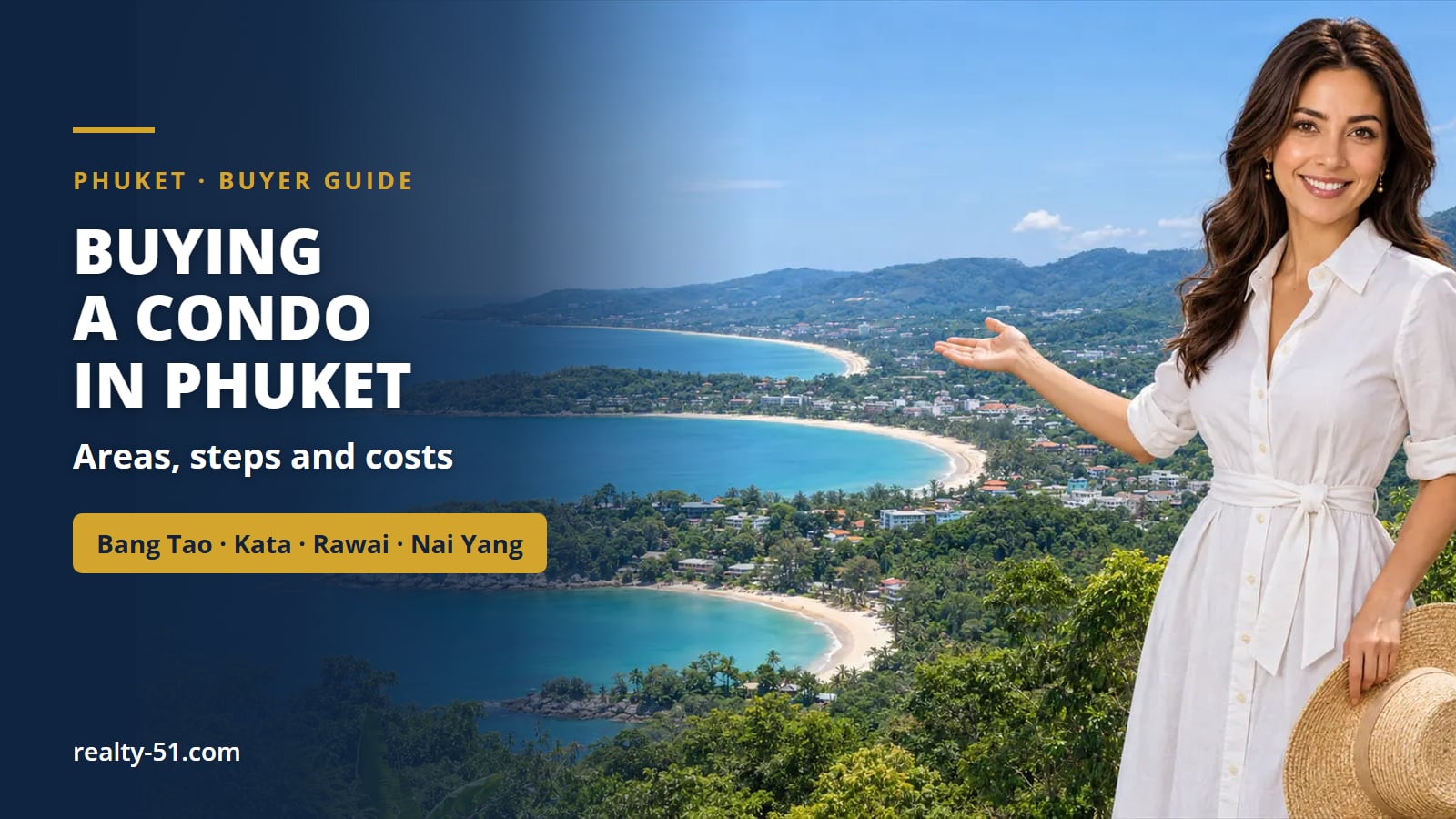
A foreigner can buy a condo on Phuket freehold, provided the building still has foreign quota available and the money arrives from abroad in foreign currency, with the bank issuing an FET certificate. The deal can be closed without visiting Thailand, using a power of attorney. What drives price and rental return most is the area, the distance to the beach, the sea view and the road up to the building.
Below: how to choose an area, what to check before reserving, the steps of the purchase, how to rent the unit out and the mistakes buyers make most often. Current listings with prices are on the page Buy a condo in Phuket.
Can a foreigner buy a condo in Phuket
Yes. A condominium unit is the only type of home in Thailand a foreigner can own outright in their own name (freehold). Two conditions apply:
- the building must have foreign quota available — the share of floor area the law allows to be sold to foreigners;
- the purchase money must come from abroad in foreign currency, and the bank must issue an FET (Foreign Exchange Transaction Form) stating the purpose "condominium purchase".
If the foreign quota is already used up, you will be offered a long-term lease (Leasehold) or a unit under the Thai quota. These are different rights with different protection, so before agreeing read Foreign freehold, Thai freehold and Leasehold: what's the difference. A foreigner cannot own land, which is why villa structures are more complicated than condos.
Phuket areas: where to buy a condo
Phuket is a large island, and every beach has its own character. Price, rental demand and lifestyle depend heavily on which coast the building is on and how far it is from the sea. A detailed look at each area is in Phuket districts: where to live and buy; here is a short summary for buyers.
Bang Tao and Laguna — the west coast, a long beach, golf courses and the gated Laguna resort with hotels and restaurants. Plenty of new condos and villas; popular with families and long-stay residents.
Surin and Kamala — small, cosy beaches between Bang Tao and Patong. Expensive hillside villas, sea-view condos, a calm atmosphere and Patong's nightlife close by.
Patong — the hub of nightlife, shopping and restaurants. Units here are the easiest to rent to tourists, but living full-time is noisy and beachfront prices per square metre are high.
Karon and Kata — wide south-west beaches, family holidays, surfing in the rainy season. A good balance between amenities and quiet.
Rawai and Nai Harn — the south of the island: relaxed life, markets, cafés and many expats who live here year-round. Nai Harn beach is one of the most beautiful on the island.
Nai Yang and the north — close to the airport, the national park and quiet beaches. Prices are lower, and the airport is 5–10 minutes away.
Phuket Town and Chalong — the east of the island, local life, schools, hospitals and large shopping malls. For those who value infrastructure more than a beach on the doorstep.
Areas compared by purpose
| Area | To live | Tourist rentals | Yearly rentals | Character |
|---|---|---|---|---|
| Bang Tao, Laguna | Yes | Yes, seasonal | Yes, families | Resort, golf, new projects |
| Surin, Kamala | Yes | Yes | Average | Quiet, views, pricey hillsides |
| Patong | Noisy | Best demand | Average | Nightlife, shopping |
| Karon, Kata | Yes | Yes | Yes | Balance of quiet and amenities |
| Rawai, Nai Harn | Best choice | Average | Yes, expats | Year-round living, markets |
| Nai Yang, north | Yes | Average | Average | Near the airport, lower prices |
| Phuket Town, Chalong | Yes | Weak | Yes, families | Schools, hospitals, malls |
If you are buying to live, look at Bang Tao, Rawai and Nai Harn. For tourist rentals, look at Patong, Karon, Kata and buildings within walking distance of the beach.
How to choose a condo in Phuket: checklist
In Phuket, price and demand come down to three things: distance to the beach, sea view and the road to the building. A unit five minutes' walk from the sea rents faster and holds its value longer.
What to check before buying:
- how many minutes on foot to the beach, or whether you need a car — many buildings sit on hills, and you have to drive to the sea;
- the sea view, and whether a neighbouring construction could block it — tenants pay noticeably more for a view;
- the road to the building in the rainy season: hillsides can have steep climbs and washed-out verges;
- the maintenance fee and what it covers: security, pools, cleaning, the management company;
- how many units in the building are rented to tourists — this decides how quiet it will be to live there;
- whether the building has foreign quota available and under which ownership form the unit is offered;
- the building's rules on short-term rentals — read them before reserving, not after.
It helps to see the building at different times of day: the view and sunlight in the daytime, noise from bars and the road in the evening. If you are buying remotely, ask for the video viewing to include the walk from the building's entrance to the beach — that shows whether the advertised "5 minutes to the sea" is real.
Off-plan or ready condo
Phuket has both large listed developers and small local companies. At launch, prices are lower and the choice of sea-view units is wider. But you wait for the keys until completion: if you want to live by the sea this season or rent out straight away, a ready condo makes more sense.
| Criterion | Off-plan | Ready condo |
|---|---|---|
| Entry price | Lower at launch | Market price |
| Choice of views and floors | Wider | Only what is on sale |
| Payment | Instalments on the developer's schedule | Usually the full amount at transfer |
| When you can live or rent out | After completion | Immediately |
| Main risk | Delays, project changes | Wear, condition of building and management |
| What to check | Documents, EIA, quota, payment schedule | Condition, maintenance arrears, rental history |
How payments before completion work is explained in Developer payment plans in Thailand.
What to check in an off-plan project before reserving
Before a reservation we check:
- the land title (chanote) and building permit — the island has seafront and hillside zones where high-rise construction is restricted;
- the environmental impact assessment (EIA) — a large condominium cannot start construction without it;
- the building's available foreign quota — without it the unit cannot be registered freehold to a foreigner;
- the payment schedule and what happens if the developer misses the completion date;
- the developer's completed buildings: how they look after a few years and how the management company performs.
We will tell you honestly what we don't like about each project and show options from different developers. The companies we work with are on the developers page, and all projects are in the condo projects section.
What to check in a ready condo
With a resale unit, condition and history come first. Ask the seller for a certificate from the management company confirming there are no maintenance arrears — the Land Department will not register the transfer without it. Look at how the building has survived several rainy seasons: signs of leaks, mould in corners, the state of the pool and lifts. If the unit has been rented out, ask for the real rental history — how many months a year it was occupied and at what price.
How to buy a condo in Phuket: step by step
The process is the same for off-plan and ready units; only the payment timing differs.
- Define your goal and budget. Living there yourself, renting out or preserving capital — this determines the area, the type of building and the unit size.
- Shortlist and viewing. We select 3–5 options in different areas and show them in person or by video: the unit, the building and the route to the beach. We send floor plans, the price list and payment terms.
- Reservation. You choose a unit and we reserve it in your name. The reservation fixes the price and the specific unit.
- Due diligence and contract. We check the documents and the quota. The contract is drawn up in Thai and English — these are the legally binding versions; we can also provide a translation into your language for reference.
- Money transfer. Send the funds from abroad in foreign currency with the purpose "condominium purchase". The Thai bank issues an FET certificate — without it the unit cannot be registered to a foreigner.
- Scheduled payments. For off-plan — instalments until completion; for a ready unit — usually the full amount at transfer.
- Handover inspection. Before registration we inspect the unit, check the finishing and compile a defects list for the developer.
- Registration at the Land Department. Ownership passes at the moment of registration and the buyer receives the title deed. Taxes and fees are paid on the same day.
Which taxes and fees are paid at registration and how they are split between seller and buyer is covered in Property taxes in Thailand.
Buying a condo in Phuket without visiting
Many of our clients buy a condo in Phuket without flying to Thailand. This is legal: developers and the Land Department work with buyers through a power of attorney.
How it works:
- we shortlist options, run a video viewing of the unit, the building and the route to the beach, and send floor plans, the price list and payment terms;
- you choose a unit and we reserve it in your name;
- you review and sign the Thai–English contract remotely;
- you transfer the money from abroad in foreign currency with the purpose "condominium purchase" — the bank issues an FET certificate;
- registration at the Land Department is done under a notarised power of attorney, and we take over the unit and check the finishing.
It is best to agree the wording of the power of attorney with us before you go to the notary: the Land Department accepts the document only in the correct form, and redoing it costs weeks.
Documents for the purchase
What a foreign buyer needs:
- passport (copies at every stage; the original or a power of attorney at registration);
- FET certificate or bank confirmation of the foreign transfer with the payment purpose;
- the signed sale and purchase agreement and receipts for all payments;
- a notarised power of attorney if you are not present at registration;
- for a resale unit — the management company's no-arrears certificate and the seller's documents.
Keep all transfer certificates: you will need them at registration and later, if you decide to sell the unit and take the money out of Thailand.
Renting out a condo in Phuket after purchase
Phuket's high season runs from November to April: dry weather, calm sea, the most tourists and winter visitors. From May to October it rains and tourist numbers fall, but units are rented long-term by expats, teachers, divers and families.
What rents best:
- 1–2 bedroom units near the beach on the west coast — for the season and the winter;
- condos and villas with a sea view — tenants pay more for the view;
- homes near international schools and in Rawai — for families on yearly leases.
Renting out for less than 30 days without a hotel licence is not allowed in Thailand, and many condos ban it in their house rules. So it is safer to base your income on monthly or longer rentals — seasonal or yearly. Some complexes run a rental programme from the developer or a hotel; read its terms before buying: what share the owner receives, how many nights a year you can stay yourself and who pays for furniture repairs.
After the purchase we can find tenants, meet them, hand over the keys and look after the unit while you are away from Thailand.
How to calculate rental income honestly
Deduct from the rent not only the maintenance fee but also vacancy between tenants, the manager's commission, minor repairs and replacing furniture every few years. A beachside unit can be occupied almost constantly in high season and stand empty in the rainy season if you rely only on tourists. A yearly lease earns less per month but gives a steady income with no gaps.
Living in Phuket: healthcare, schools, transport
Phuket has international hospitals — Bangkok Hospital Phuket, Mission Hospital — and clinics with English-speaking doctors. For families there are international schools with British and international curricula, kindergartens and sports clubs.
Transport: Phuket International Airport has direct flights from Asia, the Middle East and Europe, and Bangkok is about an hour's flight away. There is no metro on the island, so almost everyone gets around by car, motorbike, taxi or ride-hailing apps. In high season the main roads can be congested — worth considering when choosing an area.
Leisure: dozens of beaches, golf courses, yacht marinas, diving and trips to the Phi Phi Islands and Phang Nga Bay. Phuket Town has an old quarter with Sino-Portuguese architecture, markets and restaurants.
Living in Phuket costs more than in Hua Hin, but the choice is wider: from quiet areas in the south to lively Patong. Many buyers choose the island for its combination of sea, international infrastructure and direct flights. And those who live here year-round like that a busy resort and a quiet seaside village are often just fifteen minutes apart.
Buying a condo does not by itself give you the right to live in Thailand. To stay on the island beyond the visa-exempt period you need a separate visa — the options are covered in Long-term visas in Thailand and DTV visa.
Phuket or Pattaya
Many buyers choose between the two resorts. Phuket is an island with cleaner sea, views and a resort feel, but living here is usually more expensive and you have to fly to Bangkok. Pattaya is closer to the capital — you can drive to Bangkok — and its condo market is larger. If you are still comparing, see condos in Pattaya and the Pattaya districts guide.
Common buyer mistakes
- Trusting "by the sea" adverts. In Phuket, "5 minutes to the beach" often means by car. Check the route on foot.
- Not checking the quota. If the foreign quota is used up, the unit will not be freehold — you need to know this before reserving.
- Transferring money without a stated purpose. Without the correct payment purpose the bank may not issue an FET, and registering to a foreigner becomes a problem.
- Counting on daily rentals. Rentals under 30 days without a licence are prohibited, and many buildings ban them in their rules.
- Ignoring the road in the rainy season. A hillside building with a steep climb is inconvenient both for living and for tenants.
- Choosing on price alone. A cheap unit in a building with weak management quickly loses its looks and its tenants.
Where to start
Send us your budget, purpose and timeline — to live, to rent out or to preserve capital. We will shortlist 3–5 options in different areas, compare prices, payment terms and running costs, tell you honestly about the downsides of each building and run a video viewing. Our search is free: the commission is paid by the developer or seller, so your price is the same as at the sales office.
FAQ
Can a foreigner own a condo in Phuket?
Yes, a condominium unit can be registered freehold to a foreigner if the building has foreign quota available and the money came from abroad in foreign currency with the bank issuing an FET certificate. A foreigner cannot own land.
Can I buy a condo in Phuket without coming to Thailand?
Yes. We run the viewing by video, the contract is signed remotely, the money is transferred from abroad, and registration at the Land Department is done under a notarised power of attorney.
Which Phuket area is best to live in, and which for renting out?
For living, people usually choose Bang Tao, Rawai and Nai Harn. For tourist rentals — Patong, Karon, Kata and buildings within walking distance of the beach. For yearly family rentals — areas near international schools and Rawai.
Can I rent out my condo on a daily basis?
Renting for less than 30 days without a hotel licence is not allowed, and many condos ban it in their house rules. It is safer to count on monthly, seasonal or yearly rentals, or on a rental programme run by the developer or a hotel.
What is an FET certificate and why do I need it?
It is a bank certificate confirming that the money entered Thailand from abroad in foreign currency with the purpose "condominium purchase". Without it the unit cannot be registered freehold to a foreigner.
Which is better value — off-plan or a ready condo?
At launch, off-plan units are cheaper and the choice of views is wider, with payment in instalments, but you wait for the keys until completion. A ready condo can be lived in or rented out immediately.
How much does it cost to find a condo through an agency?
For the buyer the search is free: the commission is paid by the developer or seller, so the price is the same as at the sales office.
Find a condo in Phuket
Current condos with prices, floor plans and payment terms are on the page Buy a condo in Phuket. Tell us your goal and budget and we will send a shortlist of 3–5 options and run a video viewing.
Sources
- Department of Lands of Thailand — registration of property rights: dol.go.th
- Bank of Thailand — foreign exchange regulation and transfers from abroad: bot.or.th