How to Buy an Apartment in Bangkok: A Step-by-Step Guide for Foreigners
How a foreigner buys a condo in Bangkok: areas near BTS and MRT, checking a new project, money transfer, remote purchase and renting it out.
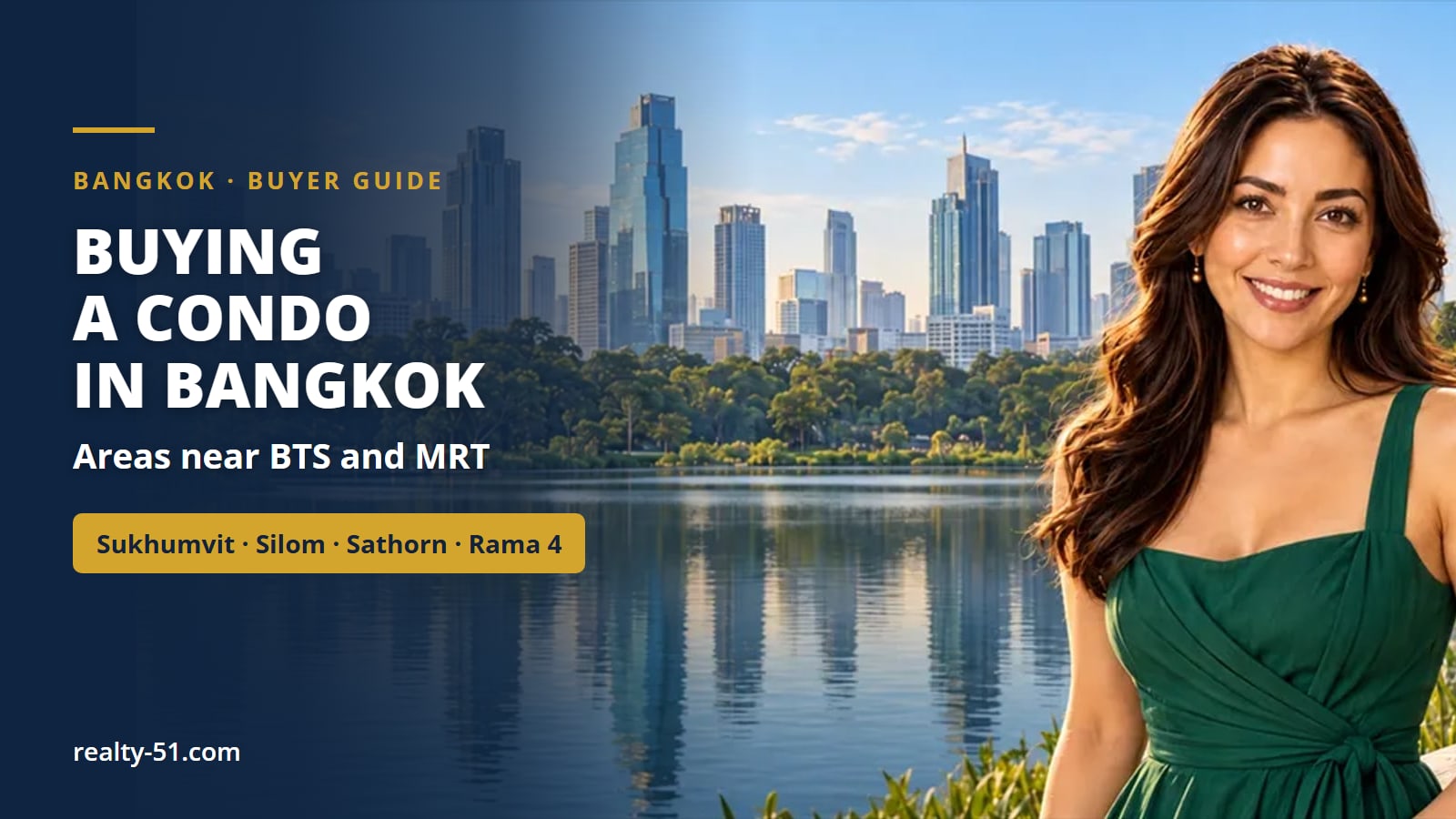
A foreigner can buy an apartment in Bangkok as Freehold if it is in a condominium with available foreign quota and the money arrives from abroad in foreign currency. What matters most when choosing is the distance to a BTS or MRT station, the area and the purpose of the purchase: living, renting out or preserving capital. The deal itself can be done remotely, under a power of attorney.
Below, in order: which areas to choose, how to check the building and the developer, how to transfer money, how a purchase works without travelling and what to expect from renting. Ready-made options with prices are collected on the page buy a condo in Bangkok.
Can a Foreigner Buy an Apartment in Bangkok
Yes. A condominium unit is the simplest and most common way for a foreigner to own property in Thailand. Ownership is registered at the Land Department in your name, and you can sell, gift or pass the apartment on by inheritance.
There are two conditions. First, the building must still have foreign quota: under the Condominium Act, foreigners may own no more than 49 % of the total unit area of the building. If the quota is used up, you can only buy as Leasehold (a long-term lease) or through a Thai structure. Second, the purchase money must come from abroad in foreign currency, and the bank must issue a certificate of receipt (FET).
Ownership formats are explained in detail in the article foreign quota, Thai quota and Leasehold. If you are considering a long-term lease right, it is also worth reading about the Sap Ing Sith right.
Bangkok Areas: Where to Buy an Apartment
Bangkok is a huge city, and prices, rents and lifestyle depend heavily on the area. There is one rule of thumb: the closer the building is to a BTS or MRT station, the easier it is to live without a car and the easier it is to rent out or resell the apartment later.
Sukhumvit is the main expat street. The stretch from Nana and Asok to Phrom Phong and Thong Lo means shopping malls, restaurants, international clinics and the BTS–MRT interchange at Asok. Apartments here are the most in demand among tenants, but also the most expensive per square metre. Further east are Ekkamai, Phra Khanong and On Nut: the same BTS line, but noticeably lower prices and more new projects.
Silom and Sathorn are the city's business centre: offices of banks and international companies, embassies, Lumpini Park. People buy here to live near work and to rent to company employees — demand is stable all year round.
Rama 4 and Rama 9 are areas developing fast. Rama 4 connects Silom, Khlong Toei and Sukhumvit; large residential and office complexes are going up along it. Rama 9 and Ratchada form a new business district on the MRT line with malls and office towers.
Ari and Phaya Thai are a quiet, green area in the north of the BTS network: cafés, small streets, a Thai atmosphere, 15–20 minutes to the centre by train.
The Chao Phraya riverside offers buildings with river views and premium hotels. People buy here for the view and status rather than for proximity to the metro.
Bang Na and Samut Prakan are closer to Suvarnabhumi Airport, with large shopping malls and the most affordable new-build prices along the new BTS line.
Comparing Areas by Purchase Goal
| Area | Price per m² (relative) | Who rents | Who the purchase suits |
|---|---|---|---|
| Sukhumvit (Nana — Thong Lo) | highest | expats, couples, families | high-demand rentals, living in the centre |
| Ekkamai, Phra Khanong, On Nut | below the centre | young professionals | first purchase, rentals near BTS |
| Silom, Sathorn | high | company and embassy staff | stable annual rentals |
| Rama 4, Rama 9, Ratchada | medium, rising | office workers | new projects, betting on area growth |
| Ari, Phaya Thai | medium | professionals, couples | living in a quiet area |
| Chao Phraya riverside | premium | affluent tenants | view, status |
| Bang Na, Samut Prakan | most affordable | families, airport staff | budget new-build purchase |
The table shows how areas compare with each other, not exact prices: those depend on the building, floor and construction stage. Current prices for specific buildings are on the page condos in Bangkok and in the projects catalogue.
How to Choose an Apartment Near the Metro
Distance to the station is the main factor affecting an apartment's price and liquidity in Bangkok. Listings say "near BTS", but the difference between 200 metres and a kilometre and a half is huge: in the heat and the rainy season, nobody walks more than 10 minutes.
What to check before buying:
- how many minutes' walk to the station and whether there is a pavement or covered walkway;
- which line the station is on: Sukhumvit and Silom BTS, the MRT Blue Line, the Airport Rail Link to Suvarnabhumi — each has its own flow of tenants;
- what the route looks like at night and in the rain — it is best to go and walk it yourself or ask us to film it;
- noise: buildings right next to the elevated BTS track are cheaper, but windows facing the line don't suit everyone.
Apartments within a 5-minute walk of the metro cost more, but rent out faster and hold their value longer on resale. On a limited budget, a smaller apartment by the station is wiser than a bigger one 20 minutes away.
We walk the route from the building to the station in advance and show it on video, so you see the real road — with pavements, crossings and how it looks in the evening — rather than an advertising promise.
What Else to Check in the Building
Besides the metro, price and comfort depend on orientation and view, floor, the condition of common areas and how well the management company works. West-facing windows in Bangkok heat up strongly in the afternoon — the air conditioning will run longer. Higher floors give a view and less noise, but in older buildings check how many lifts there are and how long you wait for them in the morning.
Be sure to find out the annual common-area maintenance fee and the sinking fund, and the condition of the pool, gym and parking. A freshly renovated lobby next to a dirty pool is a reason to ask the management company questions. In a completed building, talk to security and neighbours: they will quickly tell you about leaks, noise and short-term tenants.
New Build or Completed Apartment
Thailand's largest developers work in Bangkok, and many of them are public companies listed on the stock exchange. It is not a guarantee, but a good sign: such companies disclose their financials and value their reputation. The list of developers we work with is in the developers section.
Before booking, we check:
- the building permit and the environmental impact assessment (EIA) — a large condominium cannot start construction without an approved EIA;
- available foreign quota in the building — without it, the apartment cannot be registered to a foreigner as Freehold;
- the payment schedule: usually a reservation, then a contract and instalments during construction, with the balance on handover;
- the completion date and what happens if the developer misses it.
At the start of sales, developer prices are usually lower and the choice of layouts wider. But the earlier you buy, the longer you wait for the keys: to live in or rent out quickly, a completed building is often the smarter choice. How developer instalment plans work and what to check in the payment schedule is covered in the article on developer payment plans.
| New build | Completed apartment | |
|---|---|---|
| Price | lower at the start of sales | market price, negotiable |
| Payment | in instalments during construction | usually in full at registration |
| Keys | after the building is completed | a few weeks after booking |
| Rental | only after completion | right after purchase |
| Risk | delays, design changes | hidden defects, building history |
| What you see in advance | model, layouts, showroom | the real apartment, neighbours, management |
Step by Step: How Buying an Apartment in Bangkok Works
- Define your goal and budget: living, renting out or preserving capital. This determines the area, the size of the apartment and the choice between a new build and a completed building.
- Shortlist 3–5 options near the metro in different areas and compare prices per square metre, payment terms and running costs.
- View the apartment, the building and the route to the station — in person or on a video tour.
- Check the building: foreign quota, permits, EIA for a new build, condition and outstanding debts for a completed apartment.
- Pay the reservation deposit — it secures the apartment for you while the contract is prepared.
- Receive the sale and purchase agreement in Thai and English, check the terms and sign.
- Transfer the money from abroad in foreign currency with the purpose "purchase of a condominium" and get the FET certificate.
- Register ownership at the Land Department in person or under a notarised power of attorney; at handover, draw up a defect list.
- Connect utilities, arrange building access and, if needed, hand the apartment over to management for renting out.
Money Transfer and the FET Certificate
This is the step where mistakes happen most often. To register an apartment to a foreigner, the Land Department requires proof that the money came into Thailand from abroad in foreign currency. The proof is issued by the Thai bank that received the transfer — the FET certificate (Foreign Exchange Transaction Form).
What matters:
- transfer in foreign currency, not in baht — the conversion must take place in Thailand;
- in the payment purpose, state the purchase of a condominium and, if possible, the unit number and the building name;
- the sender's name must match the buyer's name;
- if you pay in instalments during construction, a certificate is issued for each transfer — keep them all.
Foreign exchange control rules are published by the Bank of Thailand. Before a large transfer, check limits and fees with your bank and tell the developer or seller in advance which account the money will go to.
Costs of Buying and Owning
Besides the apartment price, budget for one-off costs at registration and annual payments.
One-off: the registration fee and taxes on transfer of ownership at the Land Department (how they are split between buyer and seller is set in the contract), the sinking fund — a one-time contribution on the first purchase in a new build, electricity and water connection, furniture and appliances if the apartment comes without them.
Annual: the common-area maintenance fee, utilities, apartment insurance, land and building tax, and tax on rental income if you rent the apartment out. Rates and rules are covered in detail in the article on property taxes in Thailand; official documents are published by the Revenue Department.
Tip: before booking, ask the developer or seller for a breakdown of all costs as of the registration date — with amounts in baht. That way you see the final cost of the deal, not just the advertised price.
Buying an Apartment in Bangkok Without Travelling
Many of our clients buy an apartment in Bangkok without flying to Thailand. It is legal and common practice: developers and the Land Department work with buyers under a power of attorney.
How it works:
- we shortlist options, run a video tour of the apartment, the building and the route to the metro, and send layouts, the price list and payment terms;
- you choose an apartment and we reserve it in your name; the reservation is paid by transfer or card;
- you receive the sale and purchase agreement in Thai and English to review and sign remotely — these are the versions with legal force;
- you transfer the money for the apartment from abroad in foreign currency with the payment purpose "purchase of a condominium" — the bank issues a certificate of receipt (FET), without which the apartment cannot be registered to a foreigner;
- handover and registration at the Land Department are carried out under a notarised power of attorney; we inspect the apartment, check the finishing and draw up a defect list for the developer.
Timing depends on whether the building is completed or under construction: for a completed apartment, it usually takes a few weeks from booking to registration; for an off-plan one, until the building is completed.
You can come at any time — to see the apartment in person, sign the documents yourself or collect the keys. But it is not required for the deal itself. If you plan to stay in Thailand for long periods, sort out your visa in advance: options are described in the articles on long-term visas and the DTV visa, and entry rules in the article on visa-free entry and TDAC. Buying an apartment does not by itself give you a visa.
Documents You Will Need
- the buyer's passport (a copy for the reservation, the original or a notarised copy for registration);
- the sale and purchase agreement in Thai and English;
- FET certificates for all transfers;
- a notarised power of attorney if you are not present at registration;
- for a completed apartment — a certificate from the management company confirming no outstanding building fees (obtained by the seller).
Renting Out an Apartment in Bangkok After Purchase
Bangkok has year-round rental demand. Employees of international companies, teachers, students, doctors and entrepreneurs from all over the world live and work here, so apartments are rented for a year or longer, with no "dead" season like in resort towns.
What rents best:
- studios and one-bedroom apartments near BTS and MRT stations — rented by single professionals and couples;
- two-bedroom apartments on Sukhumvit and in Sathorn — for expat families;
- buildings near major universities and business centres.
Long-term rentals in a condominium are done under a one-year contract; renting an apartment out for less than 30 days without a hotel licence is not allowed in Thailand, and most Bangkok condos also prohibit it in their building rules. Keep this in mind if you are counting on income: calculate based on annual rentals.
After purchase, we can find a tenant, screen them, sign the contract and look after the apartment while you are in another country. For a comparison with the resort market, see Pattaya: condos for rent in Pattaya and the article on long-term rentals in Pattaya: prices and deposits.
Living in Bangkok: Healthcare, Schools, Transport, Climate
Bangkok is one of Asia's main medical hubs. International hospitals — Bumrungrad, Samitivej, BNH, Bangkok Hospital — see patients in English, and many work with international insurance. For families it also matters that the city has dozens of international schools with British, American and international curricula.
Transport: two BTS lines (Sukhumvit and Silom), several MRT lines and the Airport Rail Link to Suvarnabhumi Airport. The second airport, Don Mueang, handles domestic and low-cost flights. Getting around the city is easy by taxi and ride-hailing apps, and on the river by river boats. For a buyer, this means that in Bangkok you can live without a car if the apartment is near the metro — one of the reasons distance to the station is valued so highly here.
The climate is hot all year, with a rainy season roughly from May to October. In the rain, streets in some areas flood, so when choosing a building it is worth asking how it coped in past seasons and checking the level of the parking entrance and lobby. The most convenient time for viewings is the dry season, from November to February, but even in the rainy season downpours are usually short and don't get in the way of viewings.
Bangkok or a Resort: Which to Choose
Bangkok is chosen by those who need a big city: work, metro, hospitals, schools and annual rentals without seasonality. Resort towns — Pattaya, Phuket, Hua Hin — are chosen for the sea, leisure and daily or seasonal demand where it is permitted.
If you are unsure, compare: buy a condo in Pattaya and the area guides — Pattaya, Phuket, Hua Hin. Many buyers combine both: an apartment in Bangkok for annual rentals and an apartment by the sea for themselves.
Common Buyer Mistakes
- Buying "near BTS" based on an ad without checking the real route to the station.
- Not checking the foreign quota before booking and then having to register the apartment as Leasehold.
- Transferring money in baht or from someone else's account — without an FET certificate the apartment cannot be registered to a foreigner.
- Calculating income from daily rentals, which are prohibited in most condos.
- Looking only at the apartment price and forgetting registration costs and annual building fees.
- Signing the contract without reading the English version: the Thai and English versions have legal force.
- Taking a large apartment far from the metro instead of a compact one by the station.
Pre-Booking Checklist
- [ ] Purchase goal and budget including all costs
- [ ] Walking time to the BTS or MRT station checked
- [ ] Available foreign quota confirmed
- [ ] For a new build — permits, EIA, completion date and terms in case of delay
- [ ] For a completed apartment — no outstanding debts, building condition
- [ ] Breakdown of all payments as of the registration date
- [ ] Plan for transferring money and obtaining the FET
- [ ] Contract in Thai and English read
Frequently Asked Questions
Can a foreigner own an apartment in Bangkok?
Yes, a condominium unit can be registered to a foreigner as Freehold if the building has available foreign quota and the money came from abroad in foreign currency, confirmed by an FET certificate.
Can I buy an apartment in Bangkok without coming to Thailand?
Yes. Selection and viewings are done by video, the contract is signed remotely, and registration at the Land Department is done under a notarised power of attorney. You do not need to travel for the deal.
Which Bangkok area is best for renting out?
The highest demand is for apartments near BTS and MRT stations on Sukhumvit, in Silom and Sathorn. On a limited budget, look at Ekkamai, Phra Khanong and On Nut on the same BTS line.
Can I rent out an apartment in Bangkok on a daily basis?
Renting for less than 30 days without a hotel licence is not allowed, and most condos prohibit it in their building rules. Income should be calculated based on annual rentals.
Does buying an apartment give me a visa?
No, buying an apartment does not by itself give you a visa. For a long stay you need a separate visa — for example, a long-term visa or a DTV.
Which is better: a new build or a completed apartment?
A new build is cheaper at the start of sales and paid in instalments, but you only get the keys after the building is completed. A completed apartment suits you if you want to live in it or rent it out right away.
How much does it cost to find an apartment through an agency?
Our search service is free for buyers: the commission is paid by the developer or seller, so the price is the same as at the sales office.
Find an Apartment in Bangkok
Who Bangkok suits: those who want to live in a big city with a metro, healthcare and schools; those buying for long-term rentals with year-round demand; and those looking for a reliable way to preserve capital in liquid property in the capital.
Where to start: send us your budget, purchase goal and approximate timeline — living, renting out or preserving capital. We will shortlist 3–5 options in different areas near the metro, compare prices per square metre, payment terms and running costs, honestly tell you the downsides of each building and run a video tour. The search is free: our commission is paid by the developer or seller, so your price is the same as at the sales office. After the purchase we stay in touch — and help with tenants, property management and, if needed, resale.
Apartments and prices are on the page buy a condo in Bangkok.
Sources
- Land Department of Thailand (property rights registration): https://www.dol.go.th — checked 22.11.2026
- Bank of Thailand (foreign exchange control, transfers from abroad): https://www.bot.or.th — checked 22.11.2026
- Revenue Department of Thailand (taxes on transactions and rentals): https://www.rd.go.th — checked 22.11.2026